
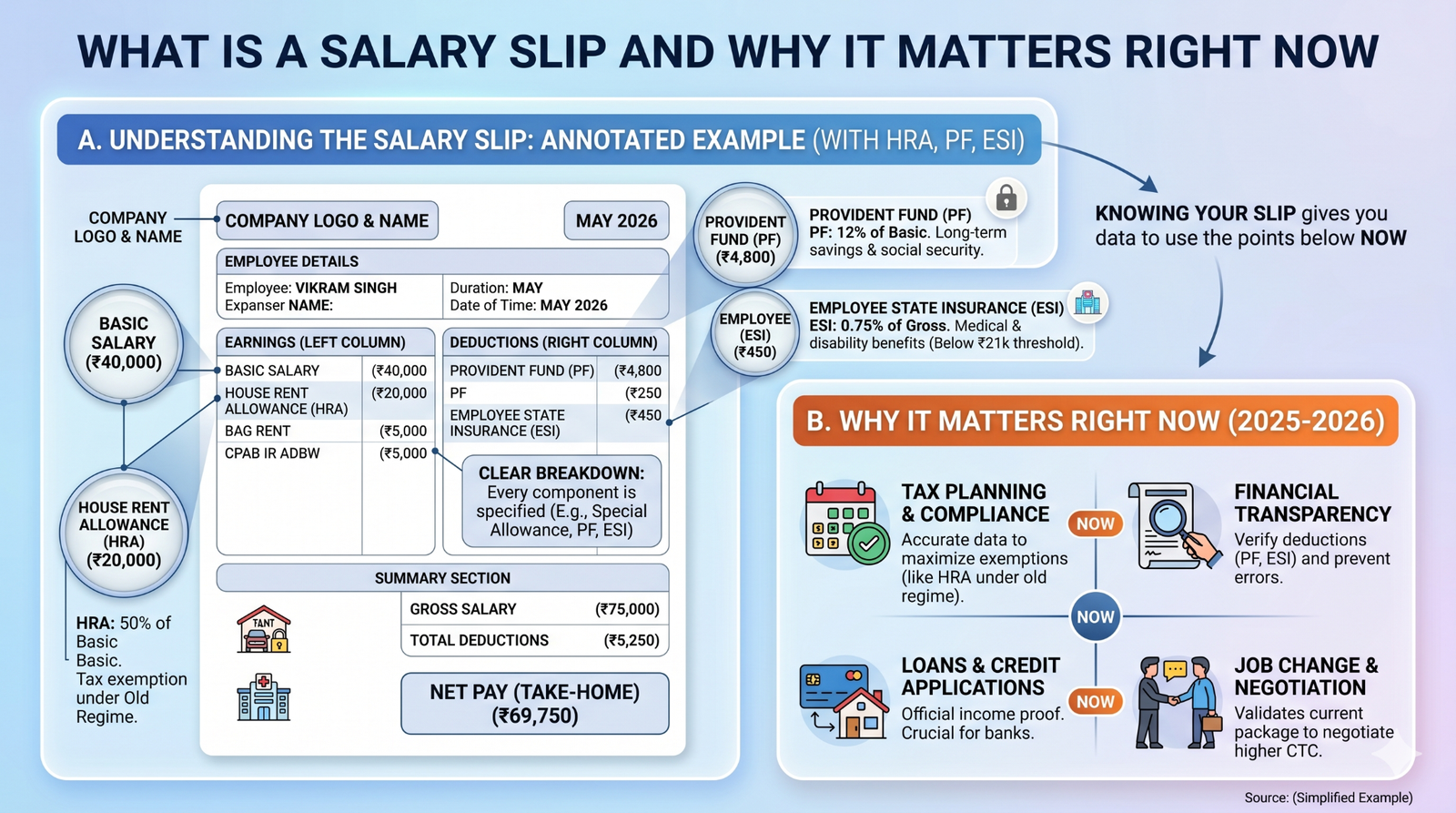
- What Is a Salary Slip and Why It Matters Right Now?
- Who This Is For Eligibility or Requirements
- How It Actually Works Complete Process
- Comparison Table Salary Slip Options Side by Side
- Real Benefits With Numbers Where Possible
- Mistakes Most People Make and the Fix
- Expert Tips That Actually Work
- Frequently Asked Questions
- Quick Summary Take This Away
- Conclusion
If you searched “Is a salary slip mandatory in India?” and landed here, you’ve found the exact answer: yes, salary slips are legally required in most cases, and employees have the right to receive them every month. This guide explains which laws say that, what your rights are, and what you can do if your company refuses to give you a slip.
You’ll also know the common mistakes employees make when they don’t receive salary slips and how to protect yourself properly. One thing that confuses many people is the difference between “not giving a slip” and “not paying salary,” and this article clears that up. It is written for Indian employees, freshers, and HR professionals who want clear, practical information on this topic.
What Is a Salary Slip and Why It Matters Right Now?
A salary slip is a document that shows how much salary was paid to an employee, including all earnings, deductions, and the net amount. It acts as proof of income and helps with tax planning, loan applications, and job changes. In India, salary slips are not just a formality they are a legal requirement under labour laws.
In 2026, salary slips are more important than ever because of the new labour codes and stricter compliance rules. Employers who fail to issue salary slips can face penalties, and employees who don’t get them can be at risk when it comes to tax and legal disputes. A salary slip protects both the employee and the employer by providing a clear record of what was paid and how it was calculated.
One observation that comes up again and again in HR work is that salary slips are often given electronically now, not as printed documents. Many companies send them via email or through an employee portal. This is perfectly fine as long as the slip is clear, accessible, and easy to understand.
Who This Is For Eligibility or Requirements
This guide is for every employee in India who receives a salary, including freshers, experienced professionals, and even those working in small businesses. It is also useful for HR managers, payroll executives, and founders who want to ensure they are following the law correctly.
The most important requirement is that the salary slip must show earnings and deductions clearly. If a company only gives a bank statement without a proper breakdown, it does not fulfill the legal requirement. The slip should show how the net salary was arrived at, including all statutory deductions like PF, ESI, and TDS.
Here is who benefits most:
- Employees who receive salary slips only sometimes or never. They need to know their rights and how to ask for slips properly.
- HR professionals who want to ensure compliance with labour laws and avoid penalties.
- Small business owners who may not have a dedicated payroll team and need to understand their obligations.
- Job seekers who need slips for loan applications or rental agreements.
Who should be extra careful is anyone working in a small or informal setup where payroll is handled manually and slips are not consistently issued. In these cases, it’s important to ask for a slip or request an electronic copy.
How It Actually Works Complete Process
Issuing a salary slip is part of the payroll process. Employers must maintain wage records and provide payslips to employees at the time of salary payment. The Payment of Wages Act, 1936, and other labour laws require that wage slips be issued to employees with their earnings and deductions clearly shown.
In practice, this means that every employee should receive a slip for each pay period, whether it’s monthly, weekly, or daily. The slip should include the employee’s name, designation, pay period, earnings, deductions, and net salary. If the slip is provided electronically, it should be accessible and printable.
One thing that most guides skip is what happens if an employee does not receive a slip. In such cases, the employee can ask HR for a copy, and if the company refuses, they can escalate the issue to the labour commissioner or file a complaint. Employers who fail to issue salary slips can face penalties under labour laws.
Another important point is that salary slips are not just for current employees. Former employees also have the right to access their salary slips for a certain period, usually for tax or legal purposes. Employers must keep these records for at least a few years, as required by law.
Comparison Table Salary Slip Options Side by Side
| Name/Option | Key Feature | Best For | Limitation | Verdict |
| Printed salary slip | Physical document, easy to keep | Small businesses and informal setups | Can get lost or damaged | Best for those who prefer physical copies |
| Email salary slip | Digital copy, easy to store | Most companies and HR teams | Requires internet access to view | Best for modern workplaces |
| HR portal slip | Accessible through employee portal | Large companies and organized HR | Needs login access | Best for centralized record keeping |
If you are an employee, you should prefer email or portal slips because they are easier to store and access. If you are an HR professional, a portal is the best option because it keeps records organized and reduces the risk of losing slips. For small businesses, a printed slip is fine, but it’s better to keep a digital backup as well.
Real Benefits With Numbers Where Possible
The biggest benefit of having a salary slip is that it provides proof of income. This is crucial when applying for loans, credit cards, or rental agreements. Without a slip, it’s difficult to prove your salary, and this can lead to delays or rejections.
Another benefit is that salary slips help with tax filing. They show all deductions, including TDS, PF, and ESI, which are important for tax calculations. When you file your income tax return, the slip is one of the key documents you need to submit.
A third benefit is that salary slips protect your rights as an employee. If there is a dispute about salary, deductions, or PF contributions, the slip serves as evidence. This is especially important if you ever need to go to a labour court or file a complaint.
One benefit that many articles miss is that salary slips help you track your savings. PF contributions, for example, are a form of forced savings. By looking at your slip, you can see how much you are saving every month and plan for the future.
Mistakes Most People Make and the Fix
One common mistake is ignoring the salary slip because it’s just a PDF or an email. People do this because they think the slip is not important. The consequence is that they may not notice errors in deductions or PF contributions. The fix is simple: always open the slip, check the numbers, and save a copy.
A second mistake is not asking for a slip when it’s not provided. This happens because employees are scared to question their employer or HR. The result is that the company may continue not issuing slips, and the employee loses proof of income. Always ask HR politely but firmly for a slip, and keep a record of your request.
A third mistake is using bank statements instead of salary slips. While bank statements show that salary was credited, they don’t show the breakdown of earnings and deductions. For legal and tax purposes, this is not enough. The fix is to request a proper slip from your employer.
A fourth mistake is not keeping salary slips for a long time. Many people delete old emails or lose printed slips. This creates problems when they need to prove their salary history. The fix is to keep salary slips for at least a few years, either in a folder or on a cloud storage service.
A fifth mistake is not understanding the slip. If you don’t know what PF, ESI, or TDS mean, you may not realize that something is wrong. The fix is to learn the basics of salary components or ask HR to explain them.
Expert Tips That Actually Work
Start by asking for a slip if you don’t get one. You can do this via email or in person, but always keep a record of your request. If the company refuses, you can escalate the issue to the labour commissioner.
Keep a copy of every salary slip, whether it’s printed or digital. This is your proof of income and can be useful in many situations, including tax filing and job changes.
If you notice an error in the slip, such as wrong PF or TDS, report it to HR immediately. The sooner you catch an error, the easier it is to correct. Employers can usually adjust the mistake in the next pay cycle.
Use salary slips to plan your taxes. They show all deductions, including TDS, PF, and ESI, which can help you calculate your tax liability and plan for investments or savings.
Finally, if you are changing jobs, ask for a salary slip from your previous employer. This is important for your new employer and for your PF transfer. Many companies require a salary slip as proof of employment and salary.
Frequently Asked Questions
Is a salary slip legally mandatory in India?
Yes, in most cases salary slips are legally required. Employers must issue wage slips to employees showing earnings and deductions. The Payment of Wages Act, 1936, and other labour laws require this.
What if my company refuses to give me a salary slip?
If your company refuses to give you a salary slip, you can ask HR for a copy. If they still refuse, you can escalate the issue to the labour commissioner or file a complaint. Employers who fail to issue salary slips can face penalties.
Can I use a bank statement instead of a salary slip?
A bank statement shows that salary was credited, but it doesn’t show the breakdown of earnings and deductions. For legal and tax purposes, this is not enough. You should still request a proper salary slip from your employer.
Do I need a salary slip for tax filing?
Yes, salary slips are one of the key documents needed for tax filing. They show all deductions, including TDS, PF, and ESI, which are important for calculating your tax liability.
How long should I keep my salary slips?
You should keep salary slips for at least a few years. This is important for tax purposes and for any legal or employment disputes. Some experts recommend keeping them for 5–7 years.
Can I get a salary slip from a previous employer?
Yes, you can ask your previous employer for a salary slip. In many cases, you will need a slip for PF transfer or for a new job. Employers are required to keep records of salaries for a certain period.
Is an electronic salary slip valid?
Yes, an electronic salary slip is valid. Many companies send slips via email or through an employee portal. As long as the slip is clear and accessible, it fulfills the legal requirement.
Quick Summary Take This Away
A salary slip is legally mandatory in India for most employees, and it shows earnings and deductions clearly. Employers must issue slips at the time of salary payment, and employees have the right to receive them. If you don’t get a slip, you can ask HR for a copy, and if they refuse, you can escalate the issue to the labour commissioner.
Salary slips are important for tax filing, loan applications, and legal disputes. They show your income, deductions, and savings, and they protect your rights as an employee. Always keep a copy of every slip, and use it to plan your taxes and savings.
Conclusion
A salary slip is a legal requirement in India and an important document for every employee. It shows earnings and deductions, protects your rights, and helps with tax filing and loan applications. If you don’t receive a slip, you have the right to ask for one, and there are legal remedies if your employer refuses.
For most employees, the smartest move is to keep a copy of every salary slip and use it to plan your finances and taxes. If you ever face a dispute, the slip is your best evidence. Always ask for a slip if you don’t get one, and keep a record of your request.
Once you know your rights, asking for a salary slip becomes a simple, confident habit. It protects your income and your future.