- What Is PF Withdrawal Tax and Why It Matters Now
- Who This Guide Is For PF Withdrawal Eligibility
- How PF Withdrawal Actually Works Full Process
- Comparison Table PF Withdrawal Options Side by Side
- Real Benefits With Numbers
- Mistakes Most People Make and the Fix
- Expert Tips That Actually Work
- Frequently Asked Questions
- Quick Summary Take This Away
You’re a 23-year-old in your first job, staring at your EPF passbook, wondering if pulling out money for a bike down payment will hit you with a surprise tax bill. This guide covers exactly when PF withdrawals get taxed in India, the 5-year rule that trips everyone up, and step-by-step ways to withdraw tax-free or minimize the hit. By the end, you’ll know if your withdrawal is safe, how much TDS might bite, and three smart moves to save tax without quitting your job or waiting years.
We focus on HR essentials for young Indians like you building careers in cities, helping you handle EPF like a pro so you keep more of your hard-earned cash. The big confusion? Most think all PF is tax-free forever. Wrong service breaks reset the clock, and employer contributions turn taxable fast. Stick with me; we’ll sort it.
What Is PF Withdrawal Tax and Why It Matters Now
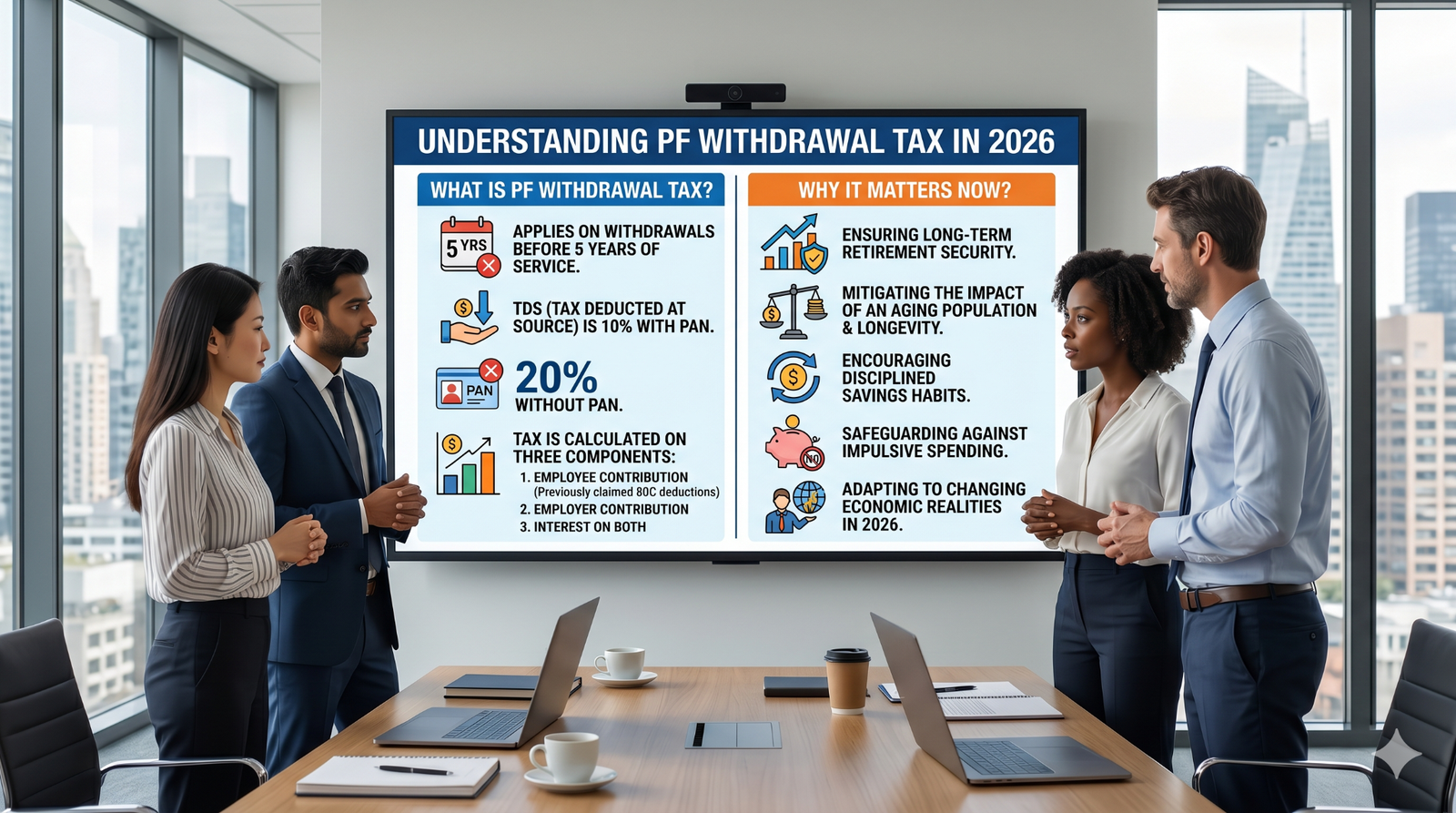
PF withdrawal tax kicks in when you take money from your Employees’ Provident Fund before finishing five years of continuous service. Your EPF has three parts: your own contributions (always tax-free), interest on yours (taxed as “other income”), and your employer’s share plus its interest (taxed as salary if early). After five years, everything’s exempt no TDS, no hassle.
This matters right now because EPFO’s 2026 updates made withdrawals easier 75% access after job loss, UPI pulls coming April but tax rules stayed strict. In 2025, over 7 crore subscribers withdrew ₹2 lakh crore, but many paid extra tax for ignoring the 5-year clock. Job hopping is common for your age group; one gap without transfer, and poof taxable.
What nobody tells you upfront: continuous service adds up across jobs only if you transfer PF each time. I’ve seen friends lose exemptions because they withdrew small amounts mid-way, breaking the chain. With 8.25% interest compounding, early tax hits your retirement hard think ₹10,000 tax today costing ₹50,000 less corpus at 60.
Who This Guide Is For PF Withdrawal Eligibility
This is for salaried youth under 30 facing emergencies, job switches, or home buys, eligible for EPF via UAN with at least 12 months service for partial pulls. You benefit most if jobless 2+ months (full access), needing medical/housing funds (tax-exempt advances), or past 5 years service (zero tax).
Skip if you’re still employed without need new 25% retention rule blocks full drain. Women post-maternity or disabled get priority. Category-wise breakdown:
- Freshers (under 2 years service): Only for medical/education/marriage advances; full settlement needs unemployment. Tax risk high without transfer history.
- Job hoppers (2-5 years total): Transfer PF every switch to build 5 years; else, TDS on >₹50k pulls.
- Settled pros (5+ years): Full tax-free freedom, but verify via passbook.
Technical musts: Active UAN, Aadhaar/PAN/bank linked, employer exit updated. No KYC? Claim rejected 80% time. If total income <₹3 lakh (new regime), Form 15G saves TDS even early. Not for self-employed or unorganized sector stick to PPF.
How PF Withdrawal Actually Works Full Process
Log into EPFO portal first. Activate UAN, link Aadhaar/PAN/bank via “Manage > KYC.” Most skip bank IFSC double-check funds bounce back.
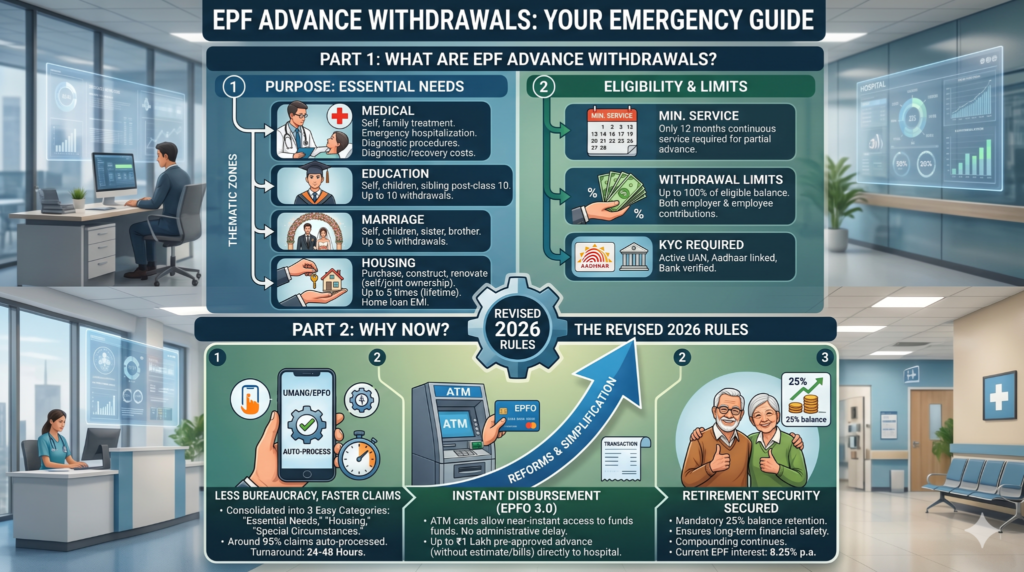
Step 1: Check eligibility (5 mins). Download passbook under “Our Services > Passbook.” Note balance, service years (continuous via transfers). For partial (Form 31), pick reason like medical (full cost) or housing (36 months salary). Full (Form 19) post-job loss. New 2026 rule: Max 75% immediate if unemployed; 25% after 1 year.
Step 2: Select claim (Form 31/19/10C, 10 mins). “Online Services > Claim.” Auto-fills data. For tax save, attach Form 15G if income <₹3L. Wrong reason? Rejected. What guides miss: Pension Form 10C auto-triggers if >1 year service claim it or lose monthly payout later.
Step 3: Aadhaar OTP verify + employer approve (1-3 days). Employer gets SMS; they attest exit. Delays here if not updated.
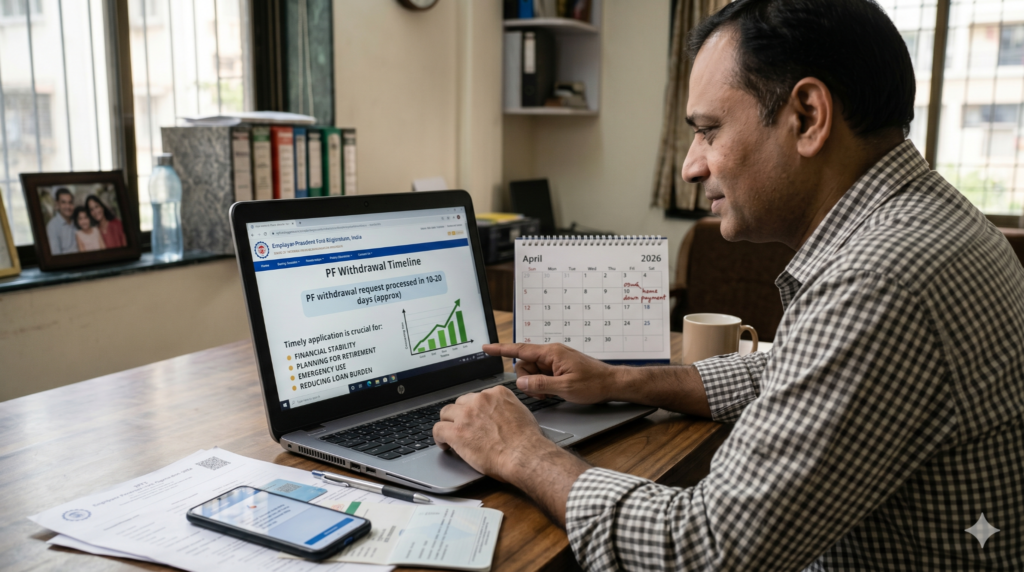
Step 4: EPFO processes (7-20 days). Track via “Track Claim Status.” TDS auto-cuts if >₹50k pre-5 years (10% with PAN). Funds hit bank; Form 16A emails for ITR.
Step 5: File ITR if taxable. Add employer interest as salary; claim 80C reversal if needed. Pro tip others skip: Unemployment >2 months allows 100% now, but tax clocks from join date. Total time: 10-30 days. Errors like inactive UAN reset to zero.
Comparison Table PF Withdrawal Options Side by Side
| Option | Key Feature | Best For | Limitation | Verdict |
| Partial Advance (Form 31) | Up to 50-90% for medical/housing/education; tax-exempt | Emergencies while employed; young pros buying home | 25% retention; purpose proof needed; max 3-10 times | Top for needs without quitting; saves tax fully |
| Final Settlement (Form 19) | 100% post-job loss (75% immediate 2026); TDS if <5 yrs | Unemployed 2+ months; full access | Taxable pre-5 yrs; breaks service chain | Essential for jobless; transfer first to avoid tax |
| Pension Withdrawal (Form 10C) | Monthly pension or lump sum; post-1 yr service | Age 58+ or reduced EPS; long-term income | No full corpus; taxable if early | Pair with PF for retirement; claim or lose |
Partial suits working youth hitting life events keeps job continuity. Final fits job switchers needing cash now, but transfer PF to dodge tax. Pension’s for later; ignore at peril.
Real Benefits With Numbers
Withdraw smart, and you pocket full EPF without tax eating 30%. Post-5 years, ₹5 lakh corpus stays ₹5 lakh save ₹50k-1.5 lakh slab tax versus early pull. Partial for medical pulls actual costs tax-free; one friend covered ₹2 lakh hospital bill, no TDS hit.
When you transfer on job change, service adds up 3 years at Job A + 2 at B = tax-free at 5. Without, ₹1 lakh employer interest taxes at 30% slab: ₹30k gone. 2026’s 75% quick access post-loss means ₹3.75 lakh immediate on ₹5 lakh balance, growing rest at 8.25%.
You’ll find your net take-home jumps 20-100% via Form 15G no 10% TDS on ₹50k+ if low income. Overlooked gem: Education advances up to 50% employee share, repeatable 10x fund MBA without loans, tax-free. Life changer: More cash now, intact retirement.
Mistakes Most People Make and the Fix
First trap: Withdrawing partial mid-job without purpose proof. Happens from urgency; consequence rejection, service break for tax clock. Fix: List medical bills/house papers upfront; use “essential needs” bucket post-2026.
Second: Forgetting PF transfer on switch. Job hoppers think “new account resets” no, it breaks continuity. TDS hits full settlement; I’ve seen ₹20k tax shock. Fix: Employer initiates transfer pre-exit; check passbook for merged balance.
Third: Skipping Form 15G on <₹3L income pre-5 years. Assume “small tax anyway” 10% gone forever if not claimed back. Fix: Download Form 15G, fill income details, upload with claim if total FY income below slab.
Fourth: Wrong bank/IFSC entry. Panic-type during claim; funds return, 15-day delay. Fix: Verify via “Manage > Bank” pre-claim.
Fifth: Pulling >₹50k pre-5 years without PAN. Rate jumps 20-30%; common for fresh UAN. Fix: Link PAN in profile instantly.
Expert Tips That Actually Work

Tip 1: Time full withdrawal after exactly 2 months unemployment 2026 rule unlocks 75% fast, tax only if <5 years total. Works because EPFO processes auto now; nets cash while job hunting.
Tip 2: For housing, claim 36 months’ salary equivalent covers deposit fully tax-free. Surprise: Counts basic+DA only; calculate via passbook to max ₹10 lakh easy.
Tip 3: Use composite claim (31+19+10C) one shot for advance, full PF, pension. Speeds to 7 days; most file separate, double wait.
Tip 4: Track service via annual passbook download gaps show early. Transfer fixes 90% tax issues retro if quick.
Tip 5: Low income? Form 15G always, even >₹50k zero TDS, claim interest back in ITR. Eligibility check: FY projection <₹3L.
Tip 6: Post-withdrawal, update ITR with Form 16A reclaim excess TDS next refund. Averages ₹5k back.
Tip 7: For marriage/education, hit 50% employee share x10 times funds wedding without bank loans, zero tax.
Frequently Asked Questions
Is PF withdrawal taxable if done before 5 years?
Yes, if <5 continuous years and >₹50k: TDS 10% (20% no PAN). Employee share tax-free; employer + interests taxable per slab. Exempt if medical/housing or Form 15G eligible. File ITR to adjust.
How to calculate 5 years continuous service for PF tax?
Counts total from first EPF join, adds if transferred no breaks/withdrawals. Job gap ok if transfer; 4 yrs + 1 yr =5. Check passbook; unemployment doesn’t count against.
What is TDS on PF withdrawal over 50000?
10% if PAN given, pre-5 years. No TDS <₹50k or post-5/post-job 2 months full. Form 15G skips if income <slab. Form 16A comes for credit.
Can I avoid tax on early PF withdrawal India?
Yes: Transfer jobs, wait 5 years, use exempt advances (medical etc.), Form 15G/15H. No 80C reversal if no prior claim. Post-2026, partials easier but tax same.
PF withdrawal rules for medical emergency?
Tax-exempt full amount needed; Form 31, self/ family/dependent proof. No service min; up to total balance minus retention. Processes fastest, 3-7 days.
Form 15G for PF withdrawal eligibility?
Under 60, resident, FY income incl withdrawal <₹3L (old)/₹7L(new)? Below exemption. Submit with claim; valid FY only. H for 60+.
Difference between PF advance and final settlement?
Advance (31): Partial employed, purpose-bound, tax-free. Final (19): Full post-job, taxable pre-5 yrs. Composite does both.
PF withdrawal after resignation when possible?
After 2 months unemployed; employer marks exit. 75% immediate 2026, rest later. Transfer if rejoining soon.
Is interest on PF withdrawal taxable?
Yes pre-5: Employee interest “other sources,” employer “salary.” Post-5 exempt. 8.25% 2025-26 rate applies.
Quick Summary Take This Away
PF tax hits pre-5 continuous years: TDS 10% >₹50k, employer parts slab-taxed. Transfer every job switch to build time tax-free. Use partial advances for medical/housing exempt, no TDS. Form 15G saves deduction if low income; always link PAN/Aadhaar first. 2026 eases access (75% post-loss) but tax rules firm plan around 5-year rule.
Your next step: Log UAN now, check passbook service years, transfer if switched jobs.
Young pros, you’ve got the full map no more tax shocks draining your EPF. Three takeaways: Prioritize transfers for exemptions, grab purpose advances tax-free, and Form 15G for low earners. Head to EPFO portal, verify KYC, and claim smart. You handle this like any career move confident and cash-smart.