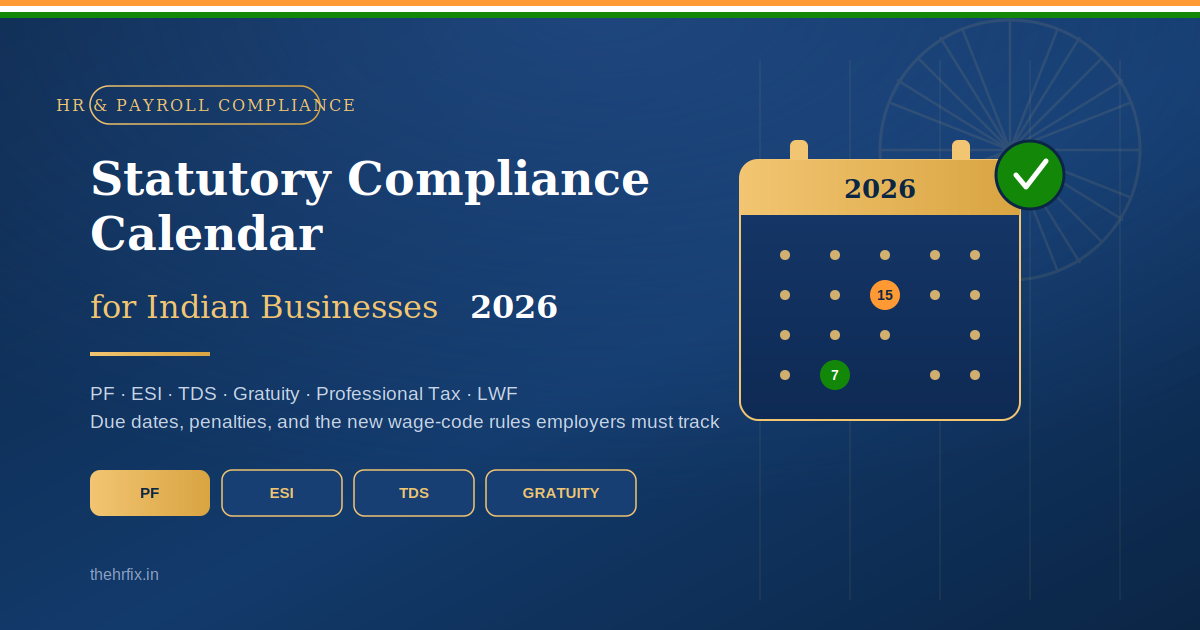
If you are searching for a statutory compliance calendar for Indian businesses, you probably want one clean answer: what to file, when to file it, and what happens if HR misses a deadline. This guide gives you exactly that, with PF, ESI, gratuity, and the other payroll duties Indian employers need to track in 2026.
The confusing part is that compliance is no longer just monthly payroll work; it now sits across labour law, state rules, and the newer wage definitions that affect salary structure, deductions, and final settlement calculations.
What Is This and Why It Matters Right Now
A statutory compliance calendar is a month-by-month plan of legal payroll and HR duties an employer must complete on time. For Indian businesses, that usually means PF deposits, ESI deposits, TDS payment, professional tax where applicable, labour welfare fund, return filings, record keeping, and exit settlements.
It matters more now because the labour-code era has tightened the link between salary structure and compliance. The Code on Wages definition of wages, which took effect on 21 November 2025, affects how PF and gratuity are worked out, and the Labour Ministry’s FAQs confirm that the revised wage definition applies from that date.
In practice, this means the old “set payroll once and forget it” approach is gone. HR teams now have to check monthly dues, yearly returns, employee coverage limits, and state-specific obligations in one system, or the mistakes show up later as interest, damages, and messy full-and-final settlements.
One thing many guides miss is this: compliance is not only about paying on time. It is also about using the right base salary, because a bad salary structure can quietly create months of underpaid PF or incorrect gratuity later.
Who This Is For
This calendar is for employers who run payroll in India, especially startups, agencies, D2C brands, factories, retailers, and service companies with regular staff. It is also useful for HR interns, payroll executives, founders handling compliance themselves, and small business owners who need a simple system instead of scattered reminders.
It is less useful if you are a sole proprietor with no employees, or if your business has no statutory payroll obligations yet. Once you hire even one employee, though, compliance starts to matter fast, because some obligations are monthly and some depend on salary bands, state location, or employee type.
- Employers with salaried staff. These businesses usually need PF, ESI, TDS, and often PT or LWF. The calendar helps avoid last-minute deposits and return filing stress.
- Companies with multi-state teams. State rules create the biggest confusion here. Professional tax and labour welfare fund deadlines can differ by state, so a single national payroll date is not enough.
- Businesses with fixed-term employees. These teams need special attention for gratuity timing and exit processing under the post-2025 framework.
The most misunderstood requirement is salary base design. If basic pay is too low compared with total pay, the wage calculation can become non-compliant under the new wage rules, which then affects PF and gratuity.
That is why this topic is not just for payroll accountants. It is also for founders who shape salary structures and for young HR teams trying to stop avoidable compliance mistakes before they become expensive.
How It Actually Works
The cleanest way to run compliance is to treat it as a fixed monthly cycle, not as separate one-off chores. First, you map every employee into the correct bucket: PF-eligible, ESI-eligible, PT-applicable, LWF-applicable, and gratuity-relevant. Then you build one payroll sheet that calculates each statutory item using the right wage base and the right state rules.
Next, you lock due dates into a calendar. For many employers, PF and ESI are due by the 15th of the following month, while TDS is commonly due by the 7th for most months; state levies then sit on top of that schedule.
After payroll is processed, the challans and returns must be filed from the correct portal with clean employee data. The EPFO ECR, ESIC contribution, and income-tax return records should match your payroll ledger, because mismatches are where audits begin.
The second stage is where most teams get sloppy: wage-base checking. Under the revised wage definition, a large share of allowances cannot be used to keep basic pay artificially low, and the Labour Ministry FAQs confirm the 50% wage rule is now active from 21 November 2025.
That matters because PF is linked to the contribution base, and gratuity is also linked to wage definition. If you only “process payroll” without checking the structure, the figures may look fine this month and still be wrong in the long run.
A practical example: if your startup gives a very small basic salary and loads the rest into allowances, your PF may be understated today but corrected later, creating back-pay risk and employee distrust.
The third stage is month-end and exit work. Month-end means checking whether PF, ESI, TDS, PT, and LWF have been deposited and whether the return set is complete. Exit work means completing full and final settlement quickly, because the payroll and labour-code framework now expects speed and cleaner closure processes than many older HR teams are used to.
What nobody warns new HR teams about is that exits expose all hidden payroll errors. If one employee leaves and gratuity, leave balance, PF, and final salary do not line up, the issue becomes visible immediately and is much harder to fix than a routine monthly filing.
Comparison Table Compliance Items Side by Side
| Name/Option | Key Feature | Best For | Limitation | Verdict |
| PF | Monthly retirement contribution, usually deposited by the 15th of the following month | Most salaried employers | Needs correct wage base and clean UAN data | Essential for nearly every growing business |
| ESI | Health insurance-linked social security for eligible wage bands, usually due by the 15th | Lower- and mid-wage employee groups | Only applies within wage ceiling rules | Critical where employee wages fit the coverage band |
| Gratuity | End-of-service benefit based on service and wage definition | Longer-serving staff and fixed-term cases | Easy to miscalculate during exits | Must be planned from day one, even if paid later |
| PT / LWF | State-specific deductions and deposits | Multi-state employers | Deadlines vary by state | Useful only if you track each work location separately |
PF and gratuity are the two items most likely to create future cost if salary structure is wrong. ESI is simpler in formula but easier to miss because coverage changes when wages cross the threshold. PT and LWF are the “small” items that often cause the most admin headaches for businesses with staff across different states.
Real Benefits
When you actually run a proper compliance calendar, the first benefit is fewer penalties and less fire-fighting. That sounds obvious, but the real value is time: your HR team stops chasing every deadline manually and can spend more time on hiring, attendance, and employee support.
The second benefit is cleaner payroll math. A correct calendar forces you to review wage base, coverage, and exits every month, which reduces the kind of quiet errors that show up only when someone resigns.
The third benefit is stronger trust with employees. When PF appears on time, ESI is correct, and full-and-final settlement is not delayed, staff feel that the company is organized and fair.
There is also a benefit most articles skip: easier investor or audit readiness. If your records are clean month by month, due dates, challans, and returns are easy to prove later, which helps in due diligence, payroll audits, and lender checks.
In practical terms, this can save hours during a compliance review because you are not rebuilding history from WhatsApp messages and old spreadsheets. That alone is worth the discipline for small teams trying to scale fast.
Mistakes Most People Make and the Fix
A common mistake is treating PF and ESI as simple deductions instead of system rules. People do this because payroll software makes the math look automatic, but the wrong wage base still produces the wrong output. The fix is to review salary structure before payroll run, not after.
Another mistake is ignoring state differences for PT and LWF. This happens when a team has mostly one-office experience and assumes India has one payroll rhythm. The consequence is missed state filing dates, especially in multi-location setups, so the fix is a state-wise compliance sheet attached to the master calendar.
A third mistake is waiting until resignation to think about gratuity. That usually happens because gratuity feels like a future benefit, not a current task. The problem is that a bad wage definition or missing service record becomes expensive at exit, so the fix is to track service date, wage base, and contract type from the first payroll cycle.
A fourth mistake is leaving full-and-final settlement for later. Many teams do this because exits arrive suddenly and payroll teams are already busy, but delayed settlement creates employee frustration and can expose other compliance gaps. The fix is to keep a separate exit checklist for salary, leave, PF, gratuity, and document handover.
A fifth mistake is using one payroll template for every employee type. Fixed-term employees, eligible ESI employees, and staff crossing coverage thresholds do not all behave the same under compliance rules. The fix is to segment payroll logic by category instead of applying one generic formula to everyone.
Expert Tips That Actually Work
Start with one master calendar, not five different trackers. The reason this works is simple: when every due date sits in one view, the team sees overlap between PF, ESI, TDS, PT, and exit work before the deadline arrives.
Keep a separate “state layer” inside the calendar. That means one column for national deadlines and another for state-only items like PT and LWF, which is far easier than searching through random reminders later.
Use a pre-payroll compliance check every month. This is the step most small teams skip, and it is the one that prevents wrong deductions before challans are filed. In practice, it means checking employee list, wage base, new joiners, exits, and salary changes before payroll is locked.
Review basic pay percentages when anyone gets a raise or role change. Under the wage rules, salary structure matters more than many founders expect, and a routine raise can accidentally push the payroll into a different compliance pattern.
Set one person as the owner for each return type. Shared responsibility sounds safe, but in real teams it often means nobody feels fully responsible, and the filing gets delayed.
Keep exit documentation ready before it is needed. That sounds small, but it prevents the worst kind of payroll scramble, where gratuity, final salary, and leave encashment are all being reconstructed on the same day.
One surprising tip: keep a “threshold watch list” for employees near the ESI ceiling or near long-service gratuity milestones. That tiny habit helps you catch compliance changes before the payroll cycle closes.
Frequently Asked Questions
What is a statutory compliance calendar in HR?
It is a monthly and yearly schedule of legal HR and payroll duties an employer must finish on time. In India, that usually covers PF, ESI, TDS, PT, LWF, gratuity tracking, and return filings. The real purpose is not just reminders; it is to stop payroll errors before they become penalties or employee disputes.
Is PF mandatory for all employees in India?
PF is not the same for every employee category, but it is a core requirement for many salaried workers and covered establishments. The key thing is to check applicability and use the correct wage base when calculating contributions. If the salary structure is wrong, the PF amount can also become wrong even when the deposit date is correct.
What is the due date for PF and ESI payment?
The common monthly due date for both PF and ESI deposit is the 15th of the following month. That is why many HR teams treat the middle of the month as the real payroll deadline, not just the salary date. Missing it can create interest, damages, and a compliance backlog.
Is gratuity only payable after 5 years?
For regular cases, gratuity is generally linked to long continuous service, but the current framework also gives special treatment to fixed-term employees under the Labour Code changes. The Labour Ministry FAQs state that a fixed-term employee is eligible for gratuity after one year from the start of the contract. This is one of the biggest updates many young HR teams still overlook.
How do I know if an employee is under ESI?
ESI usually depends on the employee’s wage level and coverage conditions, not just job title. If wages are within the notified ceiling, the employee may fall under ESI and must be included correctly. Always check the current wage limit and the employee’s monthly pay before excluding them.
What happens if PF is filed late?
Late PF filing can trigger interest and damages, and it creates trouble in audits too. The issue is not only the money; it is also the record of non-compliance that stays attached to the employer. Once the monthly cycle is missed, the catch-up work is usually more painful than the original filing.
Do state PT deadlines differ in India?
Yes, professional tax is state-specific, so due dates and slabs can differ from one state to another. That is why a company with employees in more than one state needs separate tracking by location. A single national payroll calendar is not enough for PT compliance.
Why is the new wage definition important for compliance?
Because salary structure now affects the legal base for multiple payments, especially PF and gratuity. The Labour Ministry FAQs confirm the revised wage definition became effective on 21 November 2025. If you ignore that change, your payroll may look normal on paper while still being structurally wrong.
What is the best way to manage compliance for a small business?
The best way is to use one master calendar, one payroll checklist, and one owner for each filing type. That reduces missed dates and makes it easier to spot salary structure problems before the challan is filed. Small teams do best when they keep the process simple and repetitive instead of trying to remember rules from memory.
Quick Summary Take This Away
A statutory compliance calendar is the simplest way to keep Indian payroll legal, calm, and predictable. It helps you track PF, ESI, gratuity, TDS, PT, and other duties without depending on memory or last-minute panic. The biggest change in 2026 is that salary structure now matters much more than before, because the revised wage rules affect PF and gratuity calculations.
If you run a business with employees, you need both a monthly filing rhythm and an exit checklist. That combination is what keeps monthly payroll and full-and-final settlement clean.
The smartest move is to build one calendar, one review process, and one record-keeping system for all statutory items. Do that first, then improve the details month by month.
Start by mapping every employee to the right compliance bucket this month.
Conclusion
The main thing to remember is that compliance is now a system, not a last-day task. PF and ESI have fixed monthly rhythms, gratuity depends on service and wage definition, and state items like PT and LWF make multi-location payroll more complex.
The second takeaway is that salary structure is no longer a back-office detail. Under the revised wage rules, it shapes what you pay, what you deduct, and what you owe later.
The third takeaway is that clean records are part of compliance too, not just the filing itself. When your data is structured, every future audit, exit, or employee query becomes easier to handle.
Build the calendar once, keep it current, and use it every month with discipline. You can make payroll compliance simple when the process is clear.