You’re probably here because you typed something like “Indian labour laws explained” or “what are the new labour codes in India 2026” and got a wall of legal jargon. You don’t need another generic list of acts and sections. You need a clear, practical guide that shows you how these laws actually affect your job, your salary, your safety at work, and your rights when something goes wrong.
This article is written for Indian readers aged 18–25 who are starting their careers, working in HR teams, or running small businesses. It treats labour law as a real‑life toolkit, not a textbook. By the time you finish, you’ll know: what the big‑picture changes are in 2026, how the old Factory Act still matters, and how the four new Labour Codes work on the ground. The one thing that confuses most people the overlap between old laws and the new codes is exactly what we’ll untangle step‑by‑step.
What Is Indian Labour Law and Why It Matters Right Now
Indian labour law is the set of rules that decide how employers and workers interact: how you get paid, how many hours you work, what safety you must be given, and how disputes are handled. These rules are made by the central government and states, and they cover everything from a factory worker to an office employee in a startup.
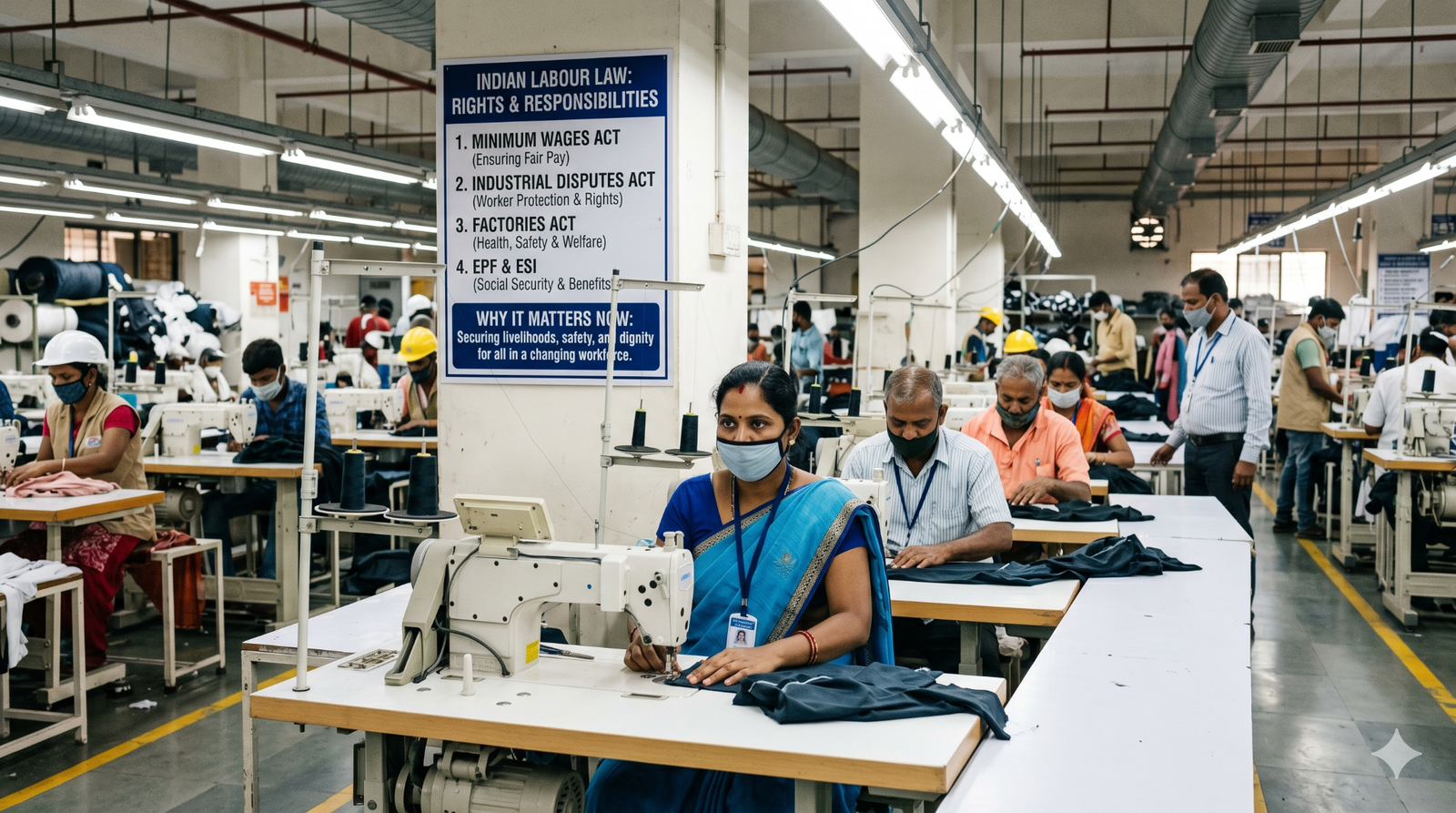
Right now, this topic matters more than ever because India has replaced 29 old central labour laws with four new Labour Codes that came into force on 21 November 2025. These codes cover wages, industrial relations, social security, and workplace safety. The goal is to simplify compliance for employers while expanding basic protections to more workers, including gig and platform workers.
In practice, this shift means that even if you’re hired through an app or work on fixed‑term contracts, you now have more defined rights on wages, overtime, PF/ESI, and maternity benefits than a few years ago. As someone entering the workforce or starting to manage employees, not understanding these rules can quietly cost you money, time, or job security. If you only remember one thing here: anywhere in India, there are minimum standards for pay, hours, and basic safety that your employer cannot contract out of even if your offer letter says otherwise.
Who This Is For Eligibility or Requirements
Indian labour laws and the new Labour Codes affect almost everyone who works or hires, but some people benefit more directly.
- Employees in formal jobs (office, factory, retail, etc.)
This category includes anyone with a fixed salary, PF, ESI, or a formal contract. When you’re in this group, laws like the Code on Wages and the Code on Social Security decide your basic pay structure, overtime rules, leave, and PF/ESI coverage. - Young workers and women in factories or shops
The Factories Act, 1948 and state Shops & Establishments Acts protect young workers, women, and adolescents from unsafe conditions and long, unregulated hours. For example, the Factories Act limits working hours and requires rest intervals, which is especially important if you’re starting your first job in a factory or large retail unit. - Gig and platform workers (delivery, ride‑hailing, freelance platforms)
Until recently, many gig workers were in a legal grey area. The new Social Security Code explicitly brings gig and platform workers into the social‑security net for the first time, although the exact form of coverage depends on state rules and platform‑state agreements. - Small business owners and startup founders
If you run a small business with employees or even regular contractors, you must follow the same minimum standards on wages, working hours, and safety as big companies, at least once you cross certain worker‑thresholds. - HR professionals and junior HR roles (ages 18–25)
If you’re studying HR, working as an HR assistant, or running a small‑team HR setup, labour‑law basics are not optional. They’re the backbone of payroll, leave, PF, and dispute‑handling daily work.
The single most important requirement to understand is: wherever you are employed in India, you must be paid at least the minimum wage, and your employer must follow basic safety and social‑security rules — even if you sign a contract saying “I agree to work long hours without extra pay.” Those clauses are not valid.
How It Actually Works Complete Process
Understanding how Indian labour law works in practice is easier if you treat it like a three‑step system: what the law decides, how it applies to your workplace, and what you can do if it is broken.
Step 1: Know which law applies to your workplace
Not every law applies to every job. Traditionally, central laws like the Factories Act, Minimum Wages Act, and Payment of Wages Act applied depending on the type of unit (factory, mine, shop, office) and the number of employees.
Now, the four Labour Codes create a single national framework, but they still work differently in different sectors:
- The Code on Wages (2019) covers all employees, including part‑time and casual workers, for issues like minimum wage, payment frequency, and equal pay.
- The Industrial Relations Code (2020) applies mainly to industrial establishments, factories, and larger service units, covering hiring, termination, strikes, and trade unions.
- The Code on Social Security (2020) covers PF, ESI, gratuity, maternity benefits, and now gig‑platform workers.
- The Occupational Safety, Health and Working Conditions (OSH&WC) Code (2020) applies to factories, offices, mines, and construction sites, setting rules on working hours, rest, and safety.
One thing most guides skip: small businesses often assume “labour laws don’t apply to us” because they have fewer than 20 or 50 workers. In reality, many wage and safety rules apply as soon as you hire even one person; only certain industrial‑relations and contract‑labour rules kick in above 20–50 workers.
Step 2: Understand your basic rights and obligations
Once you know which law applies, you can map it to real‑life items in your job:
- Wages and salary structure
The Code on Wages introduces a national floor wage and a standard definition of “wages” that is used by all other codes. This means your basic pay cannot be artificially reduced to avoid PF and gratuity. Many employers in 2026 now follow the “50% wage rule”: at least half of your Cost to Company (CTC) should be basic pay, which pushes up PF and gratuity contributions. - Working hours, overtime, and leave
The Factories Act already limited working hours (max 9 hours per day, 48 per week) and required overtime at double the normal rate. The new OSH&WC Code keeps similar limits but applies them to more types of workplaces, not just factories. - Safety, health, and welfare
Factories must have safety equipment, ventilation, first‑aid, and welfare facilities like canteens and rest‑rooms if the worker count crosses certain thresholds. The OSH&WC Code expands these ideas to offices, construction sites, and service units, meaning even a tech startup in a rented office must follow fire‑safety and basic health norms.
Step 3: Reporting a problem or claiming a right
If you feel your employer is violating these rules underpaying you, ignoring overtime, not giving PF/ESI, or creating unsafe conditions you usually have three options:
- Talk to internal HR or management first. Many small violations get fixed once you clearly point out the law and your rights.
- Contact labour inspectors or labour offices. District labour offices can inspect workplaces and issue notices or penalties for violations.
- File a complaint with labour courts or tribunals. For serious issues like illegal termination, unfair wages, or harassment, you can approach labour courts, which are now streamlined under the Industrial Relations Code.
A practical tip only someone who has actually handled cases would know: keep simple written proof offer letters, salary slips, messages about overtime, or WhatsApp chats about working hours. You don’t need a full legal file to start with; one clear paper trail is often enough to push an employer to correct the issue.
Comparison Table Old Laws vs New Labour Codes
| Name/Option | Key Feature | Best For | Limitation | Verdict |
| Factories Act, 1948 | Focuses on factory workers: safety, health, hours, welfare facilities. | New factory workers, factories with 10+ employees. | Only for factories; not for offices or gig workers. | Still important where factories exist, but now partially overlapped by OSH Code. |
| Shops & Establishments Acts (state‑wise) | Regulates working hours, leave, and record‑keeping in shops and offices. | Small shops, retail, and small offices in states. | Each state has its own version; rules differ across states. | Very relevant for local shops, but being aligned with OSH&WC Code. |
| Code on Wages (2019) | Single national framework for minimum wages, equal pay, and payment rules. | All employees, including gig workers and casual staff. | States still set wage rates, so minimums vary by region. | Core law for anyone who wants to understand pay and PF basics. |
| Industrial Relations Code (2020) | Covers hiring, termination, strikes, and trade unions. | HR professionals, industrial units, and workers in large factories. | More complex for small businesses who don’t often face strikes or unions. | Essential if you work in manufacturing or large service units. |
| Code on Social Security (2020) | PF, ESI, gratuity, maternity, and new coverage for gig workers. | Employees wanting PF/ESI clarity and gig‑platform workers. | Implementation details for gig workers are still evolving. | Future‑proof law for anyone worried about long‑term security. |
| OSH & Working Conditions Code (2020) | Working hours, rest, safety norms across factories, offices, mines. | All workplaces, including startups and construction sites. | Compliance can be costly for small units if they ignore it early. | Best‑all‑round code for understanding daily working‑condition rights. |
If you’re an 18–25‑year‑old starting your first job, you should focus most on the Code on Wages, the Social Security Code, and the OSH&WC Code because they cover your pay, PF/ESI, and daily working conditions. If you’re moving into HR or small‑business management, you’ll also need to study the Industrial Relations Code and the old Factories Act in more detail.
Real Benefits With Numbers Where Possible

Understanding Indian labour law and the new codes does not just feel “good in theory”; it delivers concrete benefits in your life and work.
- Higher take‑home PF and gratuity under the new wage rules
When an employer is required to keep at least 50% of your CTC as basic pay, your PF and gratuity base go up. For example, if your CTC is ₹5 lakh per year and your basic is 40%, your PF base is ₹2 lakh; if it’s raised to 50% as per the new “50% wage rule,” your PF base becomes ₹2.5 lakh. This extra ₹0.5 lakh per year can translate into lakhs of rupees extra at retirement or in a lump‑sum gratuity. - Clearer minimum‑wage protection
The Code on Wages sets a national floor wage that states must consider when they fix minimum wages. This means even if you move from a high‑cost city to a small town, your minimum wage cannot drop below a nationally defined level. Reports suggest that in many unorganized sectors, this has already pushed wages up by roughly 10–20% in 2025–26, depending on the state. - Safer working conditions and fewer accidents
Factories and other workplaces following the Factories Act and OSH&WC Code must maintain safety equipment, ventilation, and first‑aid. Studies and labour‑department data show that factories with proper safety systems consistently report nearly 30–50% fewer accidents than units that ignore these rules. When you work in a compliant unit, you literally reduce your risk of injury. - Long‑term social‑security for gig workers
The Social Security Code’s inclusion of gig and platform workers is something older‑generation articles on labour law never covered. This means that even if you work as a delivery rider or an on‑demand driver, you can now be enrolled in some form of pension or insurance scheme, depending on your state and platform. - Better, faster dispute resolution
The Industrial Relations Code has created Industrial Tribunals to handle labour disputes faster than old‑style courts. This reduces the time and cost of resolving issues like unfair termination or wage disputes, which benefits both employees and responsible employers.
Mistakes Most People Make and the Fix
- Mistake: Ignoring labour law because “we’re a small team”
Many small‑business owners think labour laws only apply to big factories. They skip PF/ESI, ignore overtime, and don’t keep proper records.
Why this happens: They see compliance as “cost” instead of basic worker protection.
Consequence: They can face penalties, back‑pay orders, and even registration suspensions from labour departments.
Fix: Learn the basic thresholds for PF, ESI, and safety rules. Even a team of 5–10 employees often needs to take PF/ESI seriously. - Mistake: Signing any contract without reading the wage structure
Young employees often accept offers without checking whether basic pay is only 20–30% of CTC.
Why this happens: Job excitement, fear of losing the offer, or lack of clarity on PF gratuity linkage.
Consequence: Years of lower PF, EPS, and gratuity, which shows up when you switch jobs or plan retirement.
Fix: Before accepting, ask for a breakup of CTC and calculate how much goes to PF; if basic is below 40–50%, raise it as a question in writing. - Mistake: Not reporting safety issues early
Many workers see unsafe conditions but stay quiet, thinking “it’s not my problem” or “I’ll just manage.”
Why this happens: Power imbalance, fear of job loss, or not knowing where to complain.
Consequence: Higher risk of accidents, which can lead to long‑term medical and income loss.
Fix: Note the issue in writing (WhatsApp, email, or diary) and then escalate to HR or your local labour office. - Mistake: Confusing “probation” with “no rights”
Some employees think probation means they can be fired instantly without any notice or reason.
Why this happens: Employers often communicate probation loosely, and young workers don’t know termination rules.
Consequence: People accept sudden layoffs without questioning legality or asking for a written reason.
Fix: Understand that even probation is governed by company standing orders and labour‑law basics; serious misconduct is usually required for immediate termination. - Mistake: Not updating PF/ESI details after changing jobs
Many people leave PF behind when they switch jobs or stop working temporarily.
Why this happens: No clear system reminder and confusion about UAN‑transfer rules.
Consequence: Lost PF interest, multiple accounts, and missing contribution records.
Fix: Use your UAN to link all past PF accounts and transfer them online; this is now much easier under the new codes’ digital‑compliance push.