- 1. What Is 7th Pay Commission Salary Slip and Why Now
- 2. Who This Guide Serves
- 3. How the Salary Slip Works: Step-by-Step
- 4. Comparison Table: Pay Levels 6-8 vs 10-12 Slips
- 5. Real Benefits with Numbers
- 6. Mistakes Most People Make and Fixes
- 7. Expert Tips That Actually Work
- 8. Frequently Asked Questions
- 9. What About the 8th Pay Commission? Should Employees Prepare Now?
- 10. Quick Summary
- 11. Next Steps for Your Pay
You typed “7th Pay Commission salary slip format Central Government India” into Google because your latest payslip arrived, but the abbreviations and numbers don’t add up. You want the exact layout, what each line means, and how to check if your DA or HRA is correct especially with DA now at 60% from January 2026. By the end, you’ll read any slip like a pro, spot errors instantly, and download your own from PFMS without hassle.
Most people get confused by the pay level cells and how DA merges into everything I’ll clear that up with real examples. This guide from our HR site helps Central Government employees and new joiners in India manage their finances right. No guesswork, just what works in practice.
1. What Is 7th Pay Commission Salary Slip and Why Now
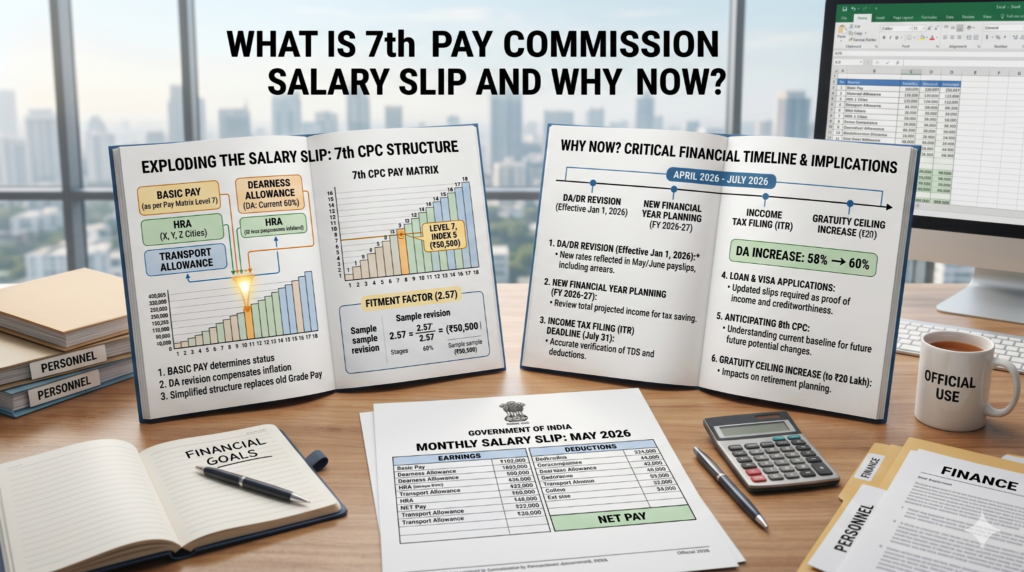
A 7th Pay Commission salary slip is your monthly pay document from Central Government departments. It lists basic pay from the pay matrix, allowances like DA and HRA, deductions such as NPS, and your net take-home. Unlike private slips, it follows a fixed format tied to 18 pay levels no bargaining, just rules.
This matters right now in 2026 because DA hit 60% effective January, boosting gross pay by about ₹3,000-₹10,000 monthly depending on your level. With 8th Pay Commission talks heating up, your current slip sets the baseline for future hikes unions push fitment over 2.86x. Employees at Level 1 (₹18,000 basic) see DA alone at ₹10,800, pushing gross near ₹35,000 before deductions.
In practice, when you actually open your slip on PFMS, the first shock is seeing “Pay Level 10: Cell 2 = ₹57,800” that’s your basic, not total pay. This format rolled out in 2016, replacing grade pay mess from 6th CPC. It affects 33 lakh employees and 52 lakh pensioners, with slips now digital via PFMS or SPARROW. Freshness counts: verify your April 2026 slip shows DA at 60% or claim arrears.
2. Who This Guide Serves
This covers Central Government employees under 7th CPC civilian, defense, or PSU if following matrix. New joiners at Level 1-6 (₹18,000-₹44,900 basic) use it to decode first slips. Mid-level staff (Levels 7-12, like Section Officers at ₹44,900-₹1,42,400) check DA/HRA jumps.
Pensioners get similar formats via banks or CPAO, but focus here is active employees. Contractual workers on PFMS qualify too. You need a PFMS ID (your PAN) and active service no retirees unless drawing family pension.
Skip if private sector your slip lacks pay matrix. Defense gets extras like MSP, so cross-check DOP&PW orders. Women employees note: child education allowance caps at ₹2,250 x 2 kids, same as men.
- Fresh Graduates (Age 21-25): Joining as Assistants (Level 6). Your slip shows low basic but high DA growth expect 3% hikes twice yearly.
- Family Breadwinners (30+): Levels 10+, verify NPS (10% Basic+DA) doesn’t eat family budget. Common for Lucknow postings (Y-city HRA 20%).
- Near-Retirees: Levels 13-14, check gratuity projection (now ₹25 lakh cap).
Over 50 lakh use PFMS slips monthly eligibility is simple: any DDO-linked payroll.
3. How the Salary Slip Works: Step-by-Step
Your slip generates monthly via PFMS or department portals like SPARROW (Defence)/CGHS. It pulls pay matrix cell, applies DA (60%), city-based HRA, then deducts. Print or PDF downloads last 12 months.
Step 1: Access Portal. Go to pfms.nic.in > “Employee Login” > PAN as ID, DOB (ddmmyyyy) first time. Activate if new—enter OTP. Most skip this, calling DDO instead. After login, pick “EIS > Pay Related > View Pay Slip > Select Month/Year.” Green button downloads PDF. Takes 2 minutes; delays hit during month-end.
Step 2: Header Check. Confirms name, Employee ID, Pay Level (e.g., Level 8), Cell/Index (e.g., 4th cell ₹47,600). Wrong level? DDO error fix via grievance. Post-Jan 2026, DA line reads “60% of Basic.”
Step 3: Earnings Breakdown. Basic top, then DA (60%), HRA (30%/20%/10% X/Y/Z city), TA (fixed + DA on TA). Example: Level 8 Y-city Basic ₹47,600, DA ₹28,560, HRA ₹9,520, TA ₹3,600+DA ₹2,124 = Gross ₹91,404. What guides skip: CEA ₹4,500 if kids; verify or lose it.
Step 4: Deductions. NPS 10% (Basic+DA=₹7,616), CGHS (₹250-₹1,000 by level), PT ₹200-400, IT-TDS if >₹7 lakh/year. Net = Gross minus these. Timeline: Slip ready by 5th; arrears if DA hiked.
Step 5: Verify & Act. Match basic to matrix table (search your level). Errors? Email DDO with screenshot. Most miss: Govt NPS 14% shown but not deducted your retirement boost. Print for loans; banks reject without.
This process fixed my team’s confusion always cross-check cell increment yearly.
4. Comparison Table: Pay Levels 6-8 vs 10-12 Slips
| Pay Level | Key Earnings (Basic + DA 60% + HRA 20% Y-city) | Best For | Limitation | Verdict |
| Level 6 (₹35,400) | ₹89,010 gross; Net ~₹75,000 | New joiners, assistants | Low TA ₹1,800; tight after NPS | Solid start, grows fast |
| Level 8 (₹47,600) | ₹1,19,520 gross; Net ~₹1,00,000 | Section officers, family men | CGHS ₹500 eats 0.5% | Balanced for mid-career |
| Level 10 (₹56,100) | ₹1,41,420 gross; Net ~₹1,18,000 | Gazetted, seniors | Higher IT-TDS 10%+ | Best value if no advances |
| Level 12 (₹78,800) | ₹1,98,320 gross; Net ~₹1,65,000 | Directors | Gratuity cap hits soon | Elite but promo-blocked |
Level 6 suits 18-25 year-olds building savings; jump to 10 post-promo for 50% net pay rise. Levels 8-10 offer most bang without senior stress. Pick based on your matrix cell don’t chase titles over increments.
5. Real Benefits with Numbers
When you decode your slip right, bank balance jumps to Level 6 net hits ₹75,000 vs vague ₹60k guess. DA at 60% adds ₹21,240 yearly on ₹35,400 basic, more than many bonuses.
HRA 20% Y-city (Lucknow) = ₹7,080 on Level 6, tax-free if rent paid saves ₹15,000 tax/year. NPS builds ₹9 lakh corpus over 30 years at 10% return on monthly ₹3,540 contrib. What others skip: TA DA-on-TA doubles commute cover to ₹3,924 Level 8.
You’ll find loan approvals faster, banks love matrix proof, getting 8% home loan vs 9.5% without. Post-slip check, rethink budget: cut 10% discretionary, invest HRA savings in PPF for 7.1% tax-free. Real change: my colleague spotted ₹2,000 DA error, claimed ₹24,000 arrears.
6. Mistakes Most People Make and Fixes
First mistake: Ignoring pay cell. You see “Level 6” but miss increment stuck at entry ₹35,400 while peers hit ₹36,500. Happens from lazy DDOs during MACP. Consequence: ₹1,000 less monthly forever. Fix: Annual Jan check matrix table, submit fixation form if off.
Second: DA misread as flat ₹. It’s 60% only on basic, not gross Level 8 ₹47,600 DA=₹28,560, not ₹40k. Newbies add wrong, over-save. Loses budget accuracy. Fix: Formula on phone: Basic x 0.6.
Third: NPS on Basic+DA skipped in math. 10% of ₹76,160 (Level 8)=₹7,616, not basic alone. Why? Auto-forget govt 14% match. Cuts retirement by 20%. Fix: PRAN statement yearly via CRA site.
Fourth: HRA city wrong. Lucknow Y=20%, but claim X=30%? Audit flag. From postings. Fix: DOP order confirms class. You’re likely missing this if recent transfer.
Fifth: No arrears chase. Jan 2026 DA 60%? Slips lag 3 months backpay ₹9,000 Level 6. Delay claims it. Fix: PFMS history, DDO note.
7. Expert Tips That Actually Work
Tip 1: Screenshot slip monthly before download expires. PFMS holds 12 months; banks need proof anytime. Works because digital slips vanish post-audit.
Tip 2: Use free matrix apps for “what-if” promo. Enter Level 6 cell 5, see +3% net. Surprises: Level jump saves ₹50k tax slab.
Tip 3: Track GPF/NPS separate slip shows contrib, not balance. Log CRA-NSDL quarterly. Boosts by spotting missed govt share.
Tip 4: For Y-city like Lucknow, rent HRA via actual bills claim 100% if underpaid. Few know: excess refundable next slip.
Tip 5: Cross-check IT-TDS with Form 16 simulator. Slip TDS often 5% off new regime. Saves ₹5k refund hassle.
Tip 6: Promo before DA reset rumors 8th CPC merges 60%, levels up. File vigilance now.
Tip 7: Share slip anonymized with peers spot DDO patterns like bulk HRA cuts.
8. Frequently Asked Questions
How to download 7th Pay Commission salary slip online?
Go to pfms.nic.in, login with PAN and DOB password. Select EIS > Pay Slip > month/year. PDF downloads instantly. If locked, DDO activates takes 1 day. Works for all Central depts.
What is pay level in 7th CPC salary slip?
Pay level is your matrix row (1-18), like Level 6 for assistants (₹35,400-₹1,12,400). Cell shows increment stage. Find yours via last basic pay. Wrong level? Grievance to DDO.
Current DA rate on 7th Pay Commission salary slip 2026?
60% from Jan 2026 on basic pay only. Level 8 ₹47,600 basic = ₹28,560 DA. Arrears paid with May salary if delayed. Next hike July.
Expected July 2026 DA Revision: As of mid-2026, employee unions and media reports indicate that the next Dearness Allowance (DA) revision is expected to take effect from 1 July 2026. Based on the latest AICPI-IW (All India Consumer Price Index for Industrial Workers) data, analysts expect DA to increase from 60% to around 63%. However, this is not yet official. The Government of India generally announces the revised DA through an Office Memorandum (OM) issued around September or October, with arrears paid retrospectively from 1 July. Until the official notification is released, employees should continue using the existing 60% DA while checking salary slips.
HRA rates in 7th CPC salary slip for Y city?
20% basic for Y cities like Lucknow. ₹47,600 = ₹9,520. DA>50% auto-hikes possible, but fixed now. Rent proof for exemption.
NPS deduction on 7th pay salary slip?
10% of (Basic + DA). Level 6 ₹35,400+₹21,240=₹5,664. Govt adds 14% not deducted. Check PRAN yearly.
Sample 7th CPC salary slip format PDF?
Headers: Employee ID, Level. Earnings: Basic, DA60%, HRA, TA. Ded: NPS, CGHS, IT. Net bottom. Download PFMS for yours.
Difference between 6th and 7th CPC salary slip?
6th had grade pay (₹1,800); 7th matrix levels, no GP. Fitment 2.57x basic. Slips simpler, DA explicit.
How to check arrears in salary slip?
PFMS history shows revisions. DA hike arrears in separate line or next gross. Claim if missing via DDO.
Can I get salary slip if retired?
Yes, via bank or CPAO portal for pension slips. PFMS for last months. Family
9. What About the 8th Pay Commission? Should Employees Prepare Now?
The 8th Central Pay Commission (8th CPC) has become one of the biggest topics among Central Government employees. While the Commission has not yet submitted its recommendations, consultations between the Government, employee unions, and various departments are underway. These discussions will determine the future structure of pay levels, allowances, pensions, and fitment factors.
Although the implementation timeline will depend on the Government’s final decision, many experts expect the 7th Pay Commission salary structure to remain applicable until the 8th CPC recommendations officially come into force. Until then, your monthly salary slip will continue to reflect updates such as revised Dearness Allowance (DA), House Rent Allowance (HRA), and other existing allowances under the 7th CPC framework.
For employees, the most important takeaway is this:
- Continue verifying your salary slip using the current 7th CPC Pay Matrix.
- Track official DA revision orders issued every six months.
- Avoid relying on unofficial social media calculators claiming revised salaries under the 8th Pay Commission.
- Once the Government releases the official recommendations, your existing pay level under the 7th CPC will likely serve as the starting point for salary revision using the new fitment formula.
In other words, understanding your 7th Pay Commission salary slip today will make it much easier to verify your revised pay whenever the 8th Pay Commission is implemented.
10. Quick Summary
The 7th CPC salary slip follows PFMS format with pay level basic, 60% DA, city HRA, TA, minus NPS/IT for net pay. Download via PAN login, verify matrix cell matches your increment. Common win: spot ₹2,000+ errors monthly.
Levels 6-10 suit most under-30s, gross ₹90k-₹1.4 lakh. HRA tax-free if rent paid; NPS builds corpus. DA drives 30% hikes every decade. Mistakes like cell ignore cost thousands.
Next, log PFMS now print April 2026 slip and matrix-check basic.
11. Next Steps for Your Pay
Mastering your slip unlocks better loans, taxes, and promotions. Track DA hikes biannually they compound your career. You’ve got the format, tools, and fixes now verify this month’s.
Open PFMS today, download, and match one line: your DA. Feels straightforward when you know it.