- What Is Salary Slip Format With HRA, PF and ESI and Why It Matters Right Now
- Who This Is For Eligibility or Requirements
- How It Actually Works Complete Process
- Comparison Table Salary Slip Format Options With HRA, PF, ESI
- Real Benefits With Numbers Where Possible
- Mistakes Most People Make and the Fix
- Expert Tips That Actually Work
- Frequently Asked Questions
- Quick Summary Take This Away
- Conclusion
If you searched for a salary slip format with HRA, PF, and ESI components, this guide gives you the exact structure, fields, and logic you need for a proper Indian slip. It also explains how to calculate and show these components clearly, so HR users, small business owners, and employees can trust the document.
The confusing part for most people is that HRA, PF, and ESI can look simple on paper, but they have rules behind them. This article clears that up by showing how to place each component in the slip, what the numbers should roughly look like, and how to avoid calculation mistakes that employees notice at once. It is written for HR-minded readers who want a practical, India‑focused format, not just a decorative template.
What Is Salary Slip Format With HRA, PF and ESI and Why It Matters Right Now
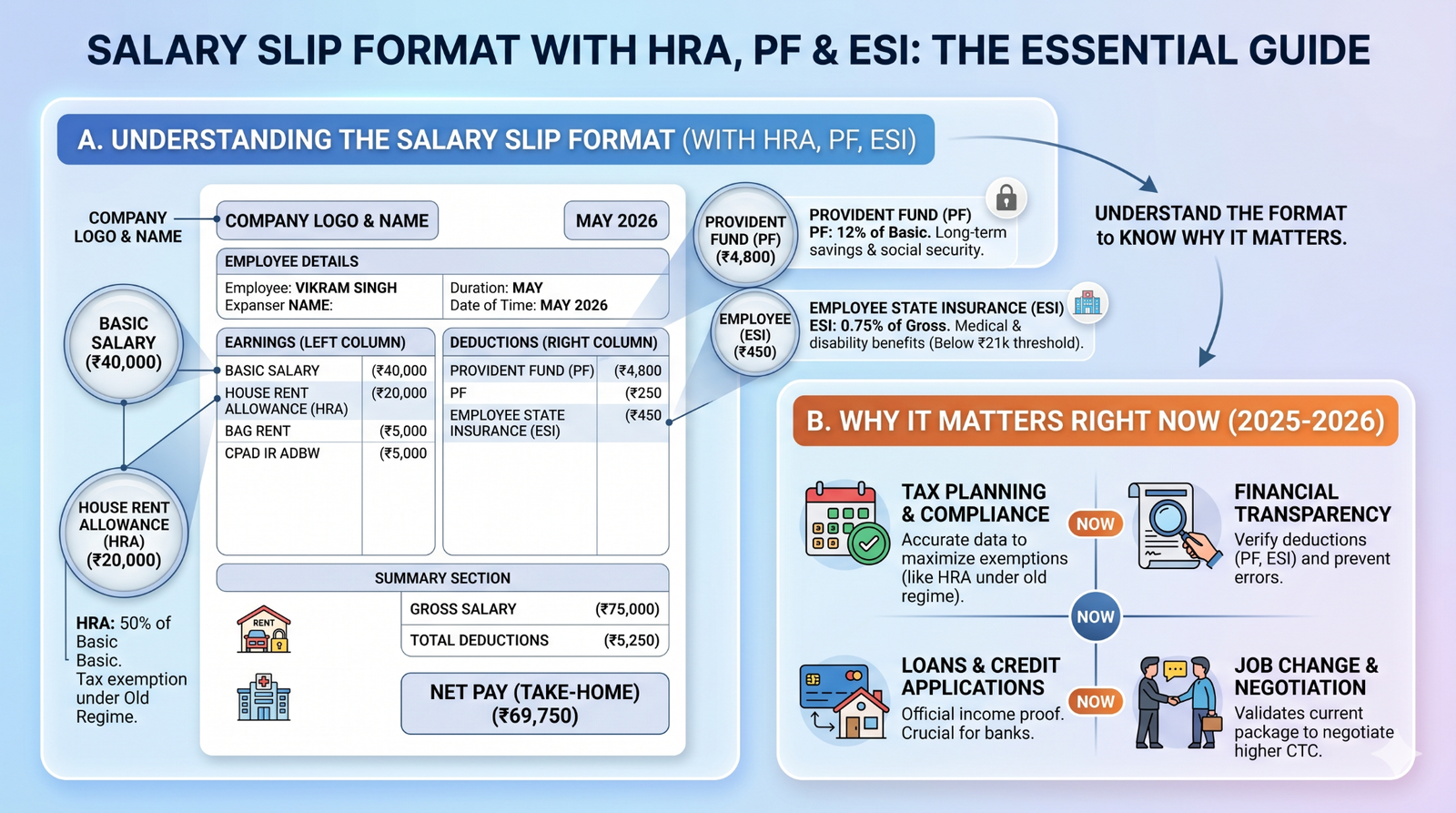
A salary slip format with HRA, PF, and ESI is a monthly payslip that clearly shows basic salary, house rent allowance, provident fund, employee state insurance, and other related deductions. The good ones show how HRA, PF, and ESI fit into the total salary structure and how they affect net pay.
This matters right now because many Indian companies still prepare salary slips without highlighting HRA, PF, and ESI properly. That creates confusion at tax time, loan‑approval time, and during salary‑structure discussions. A clear format that includes HRA, PF, and ESI helps employees understand what is exempt, what is saved, and what is paid as insurance. A useful observation from real payroll work is that the slip becomes much more useful when these components are shown separately instead of being hidden inside a single deduction line.
Who This Is For Eligibility or Requirements
This format is for HR teams, payroll executives, small business owners, founders, and employees who want to see or create a proper salary slip that includes HRA, PF, and ESI. It is also useful for freshers and job seekers who want to understand how their salary breakup works in practice.
The most important requirement is that the salary structure itself must be known before you design the slip. If you do not know what portion of CTC is basic, HRA, and allowances, the slip will look random no matter how good the layout is.
Here is who benefits most:
- HR teams in private companies. They need a clear structure that matches Indian payroll rules and employees’ expectations.
- Small businesses and startups. They often prepare slips manually and need a simple format with HRA, PF, and ESI clearly shown.
- Employees and freshers. They can use this format to compare their official slip with the structure offered in the offer letter.
- Loan and bank applicants. They need a slip that clearly shows HRA, PF, and ESI so income and deductions are easy to explain.
Who should use stronger tools instead is a company with complex payroll, multiple states, or large employee numbers. In that case, a payroll platform that auto‑calculates HRA, PF, and ESI is safer than a pure manual slip.
How It Actually Works Complete Process
The first step is deciding the basic salary and HRA percentage. In most private companies, HRA is 40–50% of basic salary, and this is the base for both tax‑exemption and PF calculations. Once you lock this, the rest of the slip becomes easier to build.
Next, add the PF and ESI logic. PF is usually 12% of basic salary from the employee side, and ESI applies if the gross salary is up to about ₹21,000 per month at 0.75% of gross salary. These percentages must match the actual statutory rules; otherwise adjustments will be needed later.
Then build the earnings section. Keep basic salary, HRA, and other allowances clear and easy to read. If your company uses DA, conveyance, medical allowance, or special allowance, show them in separate rows so the breakup is visible. The benefit of doing this is that employees can compare their taxable and non‑taxable parts more easily.
After that, build the deductions section. PF, ESI, professional tax, TDS, and any recovery should each have their own line. When you actually try this, you notice that a clean deductions section reduces “why is my salary less?” questions from employees.
Finally, calculate gross earnings, total deductions, and net pay. Gross earnings are the sum of all salary heads, and net pay is the final amount after deductions. In practice, this is the part that most guides skip in detail, but it is the heart of the slip and the line employees check first.
Comparison Table Salary Slip Format Options With HRA, PF, ESI
| Name/Option | Key Feature | Best For | Limitation | Verdict |
| Manual Excel/Word slip | Custom structure, easy to edit, good for learning | Small businesses and HR beginners | No auto‑calculation unless you build it | Best for low‑tech control |
| Free online slip generator | HRA, PF, ESI auto‑calculation with PDF export | HR teams that want quick clean slips | Limited customization for complex structures | Best for fast, guided use |
| Full payroll software | Payroll plus auto‑generated slips with HRA, PF, ESI | Growing companies and multi‑state teams | Heavier setup and higher cost | Best for scale and compliance |
If you are starting out or have a very small team, a manual Excel or Word template works well. If you want speed and cleaner math, a free online generator that handles HRA, PF, and ESI is a good middle step. If you expect the team to grow, a payroll platform is the safest long‑term bet.
Real Benefits With Numbers Where Possible
The biggest benefit is better understanding of HRA, PF, and ESI. When these components are clearly shown, you can quickly check whether PF is about 12% of basic and whether ESI applies at all based on gross salary. That alone saves time during tax‑planning and loan‑approval discussions.
A second benefit is easier tax planning. HRA can be partially tax‑exempt, so having it separated from other allowances helps you calculate House Rent Allowance exemption correctly. When you do this, you’ll find that the right breakup can actually reduce your taxable income.
A third benefit is cleaner communication with employees. If the slip clearly shows HRA, PF, and ESI, fewer people ask HR to explain why the net amount differs from the offer letter. That is especially important in small teams where HR already has multiple roles.
A benefit many articles miss is internal record‑keeping. When you keep a consistent format every month, you can compare how HRA, PF, and ESI change over time, which is useful if you adjust your salary structure or move between companies.
Mistakes Most People Make and the Fix
One common mistake is mixing HRA into a generic “allowance” line instead of showing it separately. People do this because they want to keep the slip short, but it creates confusion during tax‑exemption and loan‑application time. The fix is simple: always show HRA as a separate head if it exists in the salary structure.
A second mistake is not matching PF and ESI with the right base. For example, using 12% of gross salary for PF instead of 12% of basic salary. This happens because the user is unsure which part of the salary PF links to. The result is an incorrect PF amount that can be questioned later. To avoid this, confirm that PF is 12% of basic salary and ESI is applied only if the gross is within the threshold.
A third mistake is showing only net pay without clear breakup. This is something many HR teams are doing right now without realizing it. The consequence is that employees ignore the slip or assume the company is hiding something. Always show earnings, deductions, and net pay, even if the slip is simple.
A fourth mistake is using the same slip format for different salary structures. A structure that includes DA, for example, should show DA separately, while a structure without it should not. The fix is to keep the layout flexible and remove irrelevant heads instead of leaving them blank.
A fifth mistake is not updating the threshold logic for ESI. If the gross salary crosses the ₹21,000 limit, ESI should drop out, but some slips keep the ESI header anyway. Always check the current ESI rule and reflect it in the slip when the employee’s salary changes.
Expert Tips That Actually Work
Start with a master salary‑structure sheet that shows basic, HRA, and allowances. Reuse this in your slip so every month’s numbers are consistent. That small step reduces confusion between HR, payroll, and finance.
Use one fixed location for HRA, PF, and ESI on the slip. If these lines jump around every month, the slip feels unprofessional. Place them in the same spot each time so employees can scan quickly.
If you are using Excel, add a small note column for HRA exemption conditions. That line is not on the final slip, but it helps HR understand the tax‑exemption logic behind the amount.
For ESI, add a small remark when the employee is crossing the threshold. Something like “ESI not applicable from this month” makes the change visible without changing the structure too much. The thing that surprised me when using this is that employees stop asking “why no ESI this month” as often.
Check the slip against the UAN or PF statement once a year. In practice, this is the fastest way to catch PF mismatches before they become larger issues. If the numbers do not match, fix the slip template and payroll rules at once.
Always keep a copy of the slip in PDF for both HR and the employee. That gives you a fixed record of HRA, PF, and ESI for that month and avoids disputes later.
Frequently Asked Questions
What is salary slip format with HRA, PF and ESI components?
It is a monthly payslip that clearly shows basic salary, HRA, PF, ESI, and other deductions in separate rows so the structure is easy to read. The goal is to show how HRA, PF, and ESI fit into the total salary and how they affect net pay. This format is useful for income proof, tax planning, and employee understanding.
How to show HRA on salary slip in India?
HRA should be listed as a separate heading under earnings, with the amount and the month mentioned clearly. When the slip is for tax purposes, it helps to know that HRA can be partially exempt depending on rent paid and city. Some formats also add a small note about HRA conditions for employees who need more detail.
How is PF calculated and shown on salary slip?
PF is usually calculated as 12% of basic salary for the employee’s contribution and the same percentage for the employer. On the slip, it should appear under deductions with a clear label like “Provident Fund (PF)” and the calculated amount. If your company uses a different percentage, that should be specified in the policy, not hidden in a generic line.
When is ESI shown on salary slip in India?
ESI is shown on the slip when the gross salary is below the threshold, which is currently about ₹21,000 per month. If the employee’s salary is above that, ESI is usually not deducted, and the slip should not show an ESI line. This is something many slips get wrong, so always check the actual rule first.
Should I include HRA, PF and ESI in every salary slip?
Yes, if they are part of the actual salary structure. If your company does not offer HRA or does not apply PF or ESI for that employee, those lines can be removed instead of kept blank. A clean slip that reflects the real structure is more useful than a generic one with unused fields.
Can a small business use this format with HRA, PF and ESI?
Yes, small businesses can use this same structure. They just need to set the salary heads, decide basic, HRA, and allowances, and then apply the correct PF and ESI percentages. The format can be simple, but it should still show HRA, PF, and ESI clearly if they are relevant.
How to convert my salary slip into a downloadable PDF?
You can create the slip in Excel or Word, then use the “Save as PDF” or “Export as PDF” option in the software. Many online slip generators also let you download a PDF directly. The key is to keep the layout clean and check the PDF before sending it to employees.
Does every employee need ESI on their salary slip?
No, only employees whose gross salary is within the ESI‑eligible threshold need ESI on the slip. If an employee’s salary is above the limit, ESI should not appear as a deduction. HR should review this once a year or whenever the salary changes significantly.
How often should I update the salary slip format with HRA, PF and ESI?
Update the format whenever there is a change in salary structure, threshold, or tax rule that affects HRA, PF, or ESI. Otherwise, keep the same structure for consistency. Employees feel more confident when the slip layout remains stable even if the numbers change.
Quick Summary Take This Away
A salary slip format with HRA, PF, and ESI components should clearly show basic salary, separate HRA, and dedicated PF and ESI lines in the deductions section. The structure should match the actual salary breakup and reflect the current Indian rules on PF and ESI thresholds. This helps employees understand their taxable and non‑taxable parts, plan taxes, and use the slip for income proof.
Using a simple layout with fixed positions for HRA, PF, and ESI makes the slip cleaner and easier to compare month‑to‑month. If you are starting small, a manual template is enough; if you expect more complexity, move step by step toward a generator or payroll platform. Always keep the numbers accurate, show the breakup clearly, and save the slip in PDF for records.
If you only do one thing today, set up a master file that shows basic, HRA, and allowances, then plug those values into your slip format. That is the fastest way to build a reliable, repeatable salary slip with HRA, PF, and ESI from the next month onward.
Conclusion
A well‑structured salary slip with HRA, PF, and ESI makes payroll feel more transparent and less confusing. It helps employees see how much they are saving, insuring, and actually taking home. That clarity is just as important as the salary amount itself.
For most Indian employers, the smartest move is to standardize the format, keep HRA, PF, and ESI visible, and update it only when the law or salary structure changes. If you need more speed, use a free generator that supports these components, but never skip the basic salary‑structure check behind the numbers.
Once you get the format right, the salary slip stops being a chore. It becomes a simple monthly habit that builds trust between the company and its employees.